"Ukrainian warehouse of electrical equipment"
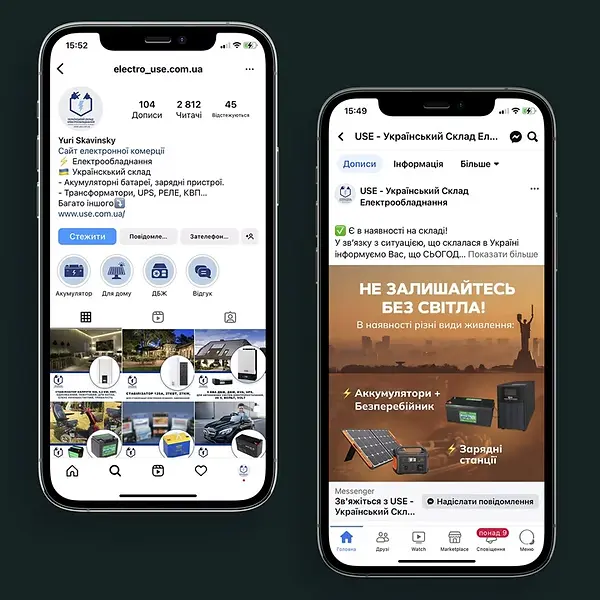
Input data

Tariff

Topic
Business of selling electrical equipment

Instagram link:

Monthly budget:
About the client:
Goal
Results
Tariff package project
Short result
.png)
70%
Subscribers grew by

1500%
Number of appeals
600%
Number of customers per month
The basis of the team

Denis
Denis is the voice of our company. He spends hours making sure that our clients feel cared for and enjoy their interactions with the company. If you have any suggestions or ideas, you can write to us.

Christina
Khrystyna is responsible for the product concept, manages the creative team. Her task is to help the customer formulate a message for the target audience and visually package it so that it is correctly perceived.

Eugene
Evgeny is the main creative engine of our team. Logical thinking, analytical mindset, but at the same time can always impress our clients with a unique approach to business.

Daria
Daria's job is to formulate the client's objectives and desires, and then communicate them to the team of specialists. The project manager has to gather his or her will into a fist and finish the task with shocking force.

Nikita
Responsibility, broad horizons, marketing vision and many more qualities that can be said about Nikita. A unique tandem is the quality and speed with which Nikita performs her work.

Karina
A native speaker and expert in foreign languages with over 10 years of experience in writing texts for various tasks. She will study your tone of voice and craft the perfect text for each specific need.
SMM case: targeted advertising for an electrical equipment warehouse
A story about how an electrical equipment warehouse with real deadlines and "hot" requests from installation crews managed to turn social media into a source of predictable B2B orders. The People Needed team worked with live operational constraints: waves of demand before tenders, seasonal peaks in switchboard equipment, and requests for urgent assembly "by the end of the week." Below are specific insights and solutions that yielded systemic results.
Client context and goals: what was “under the hood”
The requests varied in urgency and complexity: some were looking for standard assemblies for 160–250A, others were looking for specifications for a non-standard cabinet, taking into account the dimensions of the switchboard. The average check fluctuated depending on the component line and the stock in the warehouse. The owners wanted not just more leads, but predictability: for the sales department to understand when a larger share of applications would “arrive” and that these applications would contain enough data to calculate without hours of clarification.
The goals were formulated in a down-to-earth manner: keep CPL in the working range, increase the share of qualified requests in CRM, reduce “empty” applications, and also bring the strengths of the warehouse to the forefront of communication — availability, fast completion, verified certificates, and honest delivery times. For a manageable scale, we agreed to track not only the application, but also the “quality of the brief” in the form.
How the funnel was built: for real procurement scenarios
Separate streams were created for three typical situations. The first is "urgent closing of positions": creatives with an emphasis on availability and shipment "today/tomorrow", a landing page with a short form and a field for a photo specification. The second is "project calculation": calmer messages, a checklist for an engineer, a longer form with mandatory fields for current, quantity and dimensions. The third is "warehouse consultation": explanations about compatibility and alternatives.
Audiences were not limited to abstract interests - they used interactions with the content of warehouse reviews, visits to sections with specific product groups, and were similar to those who had already sent full briefs. At the lower level of the funnel, dynamic links to the catalog worked - they were connected when it was important to return people to the positions they had already viewed. A separate scenario was set up for "long" deals, where the decision is made by the procurement team together with the technical specialist.
Creatives: the language of composition, not advertising clichés
Instead of general “best prices” — subject frames: photos of real shelves, signed rows, markings on boxes, short explanations of “what goes where” and under what conditions it works. Visual schemes worked well for installation contractors: “panel for the project — complete set in 48 hours”, “cable and automation in one shipment”, “selection of replacements in the absence of a position”.
The texts were kept technical but concise: without sweeping promises, but with specifics about certificates, warranty, and logistics deadlines. Calls to action were selected based on the situation: “Get a quote,” “Attach a specification,” “Request a replacement.” This approach saved the sales department time — more “ready-made” briefs arrived in the form.
Measurement and optimization: how to understand what really works
Tracking is collected on the events "Lead", "Spec_Request", "Call_Back" to distinguish between leads "for a chat" and requests with specific technical information. The UTM structure is coordinated with CRM - this allowed us to compare the connections "creative × audience × page" not by likes, but by the fact of sale. Every week, we reviewed the intersections of audiences, removed connections with creative fatigue and moved the budget to streams with a better share of "complete" requests.
We separately monitored the quality of traffic diffusion: what happens to visitors who came "urgently" but did not fill out the form; how do those who read the checklist for engineers behave; does catalog retargeting provide additional brief details? After correcting the form fields and rearranging creatives during peak weeks, CPL returned to the working corridor, and managers received fewer "empty" requests. It is necessary to set up the same transparent analytics - leave a request for an express audit from Potrzhbni Lyudi.
What gave systematicity and how to scale it
Stability came not from one "magic" creative, but from a matrix where each element corresponds to a specific task: urgent shipments, calculation for technical specifications or consultation on replacements. For the warehouse, this means predictability of the load on logistics and assembly, for sales - more understandable shift planning and call schedules.
Scaling is seen in three planes. The first is the division of SKUs into clusters with separate offers and micro-landings (panels, automation, cable). The second is geography: testing adjacent areas with specified delivery times and local cases. The third is synchronization with search and email chains to warm up "long" applications. It is necessary to implement this model under your own warehouse restrictions - the Potrijbni Lyudi team will prepare a short roadmap with KPIs, budget and launch plan.